Coastal waters play a critical role in the global carbon cycle. The dynamic interface between land and deep ocean accounts for up to 30% of oceanic primary production, 50% of inorganic carbon burial, and 80% of organic carbon burial in marine sediments, despite covering only about 10% of the global ocean’s surface area. Yet they remain among the most challenging environments in which to monitor carbon from space. Improved information on coastal carbon dynamics contributes to a better understanding of ecosystem productivity, water quality and environmental changes in coastal regions that support economically important activities such as fisheries and aquaculture.
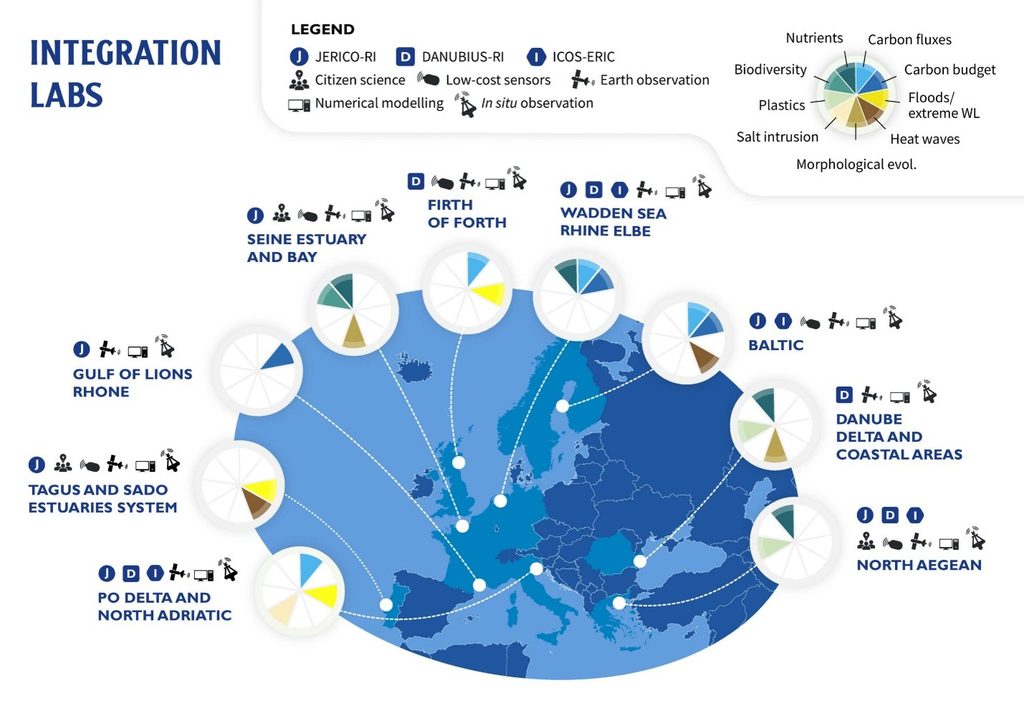
The Coastal ocean carbon alliance brings together LandSeaLot and COOL (Carbon from Earth Observation between Ocean and Land) to advance the observation and understanding of carbon dynamics in coastal environments. By combining extensive in-situ measurements with Earth observation data from Sentinel-2/Sentinel-3 and enhanced retrieval algorithms, the collaboration seeks to estimate multiple carbon pools and fluxes in complex coastal systems – namely, high turbidity/high sediments load areas under strong tidal influences, which challenge even more the retrieval of carbon-related information from satellite observations. The focus is on high-resolution datasets for Particulate Organic Carbon (POC), Particulate Inorganic Carbon (PIC), Dissolved Organic Carbon (DOC), and Primary Production (PP) as well as supporting products like remote sensing reflectances, chlorophyll-a, suspended particulate matter, and coloured dissolved organic matter (CDOM). The alliance interacts on selected Integration Labs (LandSeaLot-specific case study areas), benefiting from the vast collection of in-situ data therein, creating new opportunities to improve the accuracy and applicability of coastal carbon products.
This coordinated approach creates value for both projects and the wider ocean community, as described below:
- For COOL, access to LandSeaLot derived in-situ observations of dissolved and particulate carbon, primary productivity and suspended matter helps improve and validate Earth observation algorithms in optically complex coastal waters.
- For LandSeaLot, access to the most advanced Earth observation products to extend and complement in-situ measurements, supporting the upscaling and characterization of carbon dynamics across larger spatial and temporal scales.
- For coastal stakeholders, improved information on carbon processes contributes to a better understanding of ecosystem functioning in areas that support economically important activities such as fisheries and aquaculture.
- For the scientific community, the alliance enables the development and testing of new approaches for estimating carbon pools and fluxes in highly dynamic and complex coastal regions, helping bridge the gap between local observations and large-scale Earth observation capabilities.