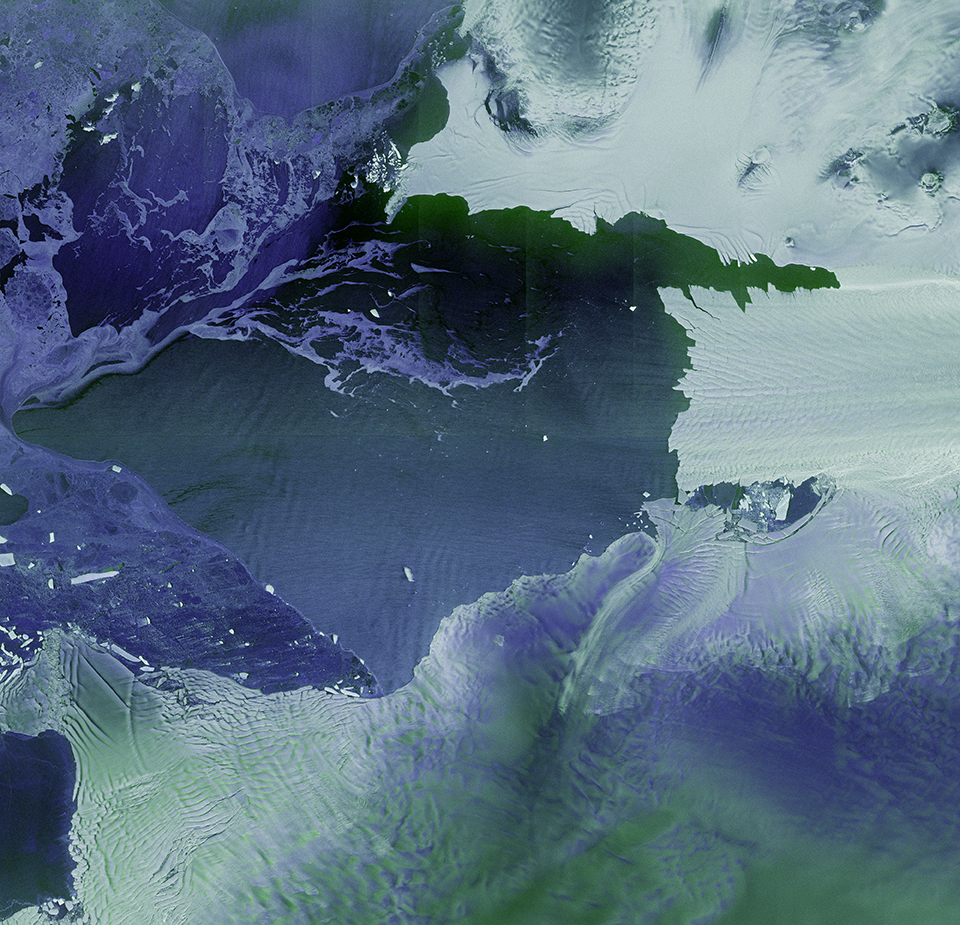
The stability of West Antarctica depends not only on how much ice is melting, but also on how the structural integrity of its floating ice shelves evolves over time. Fractures, rifts and crevasses can weaken ice shelves, alter the transmission of stress, and influence how fast ice flows towards the ocean. Understanding this coupling between damage and ice dynamics is essential for improving projections of Antarctica’s future contribution to sea-level rise, particularly in regions such as Thwaites Glacier, where ice shelves and ice tongues play a critical role in regulating grounded ice flow.
This alliance between the European Commission project PROTECT and ESA’s POLAR+ Ice Shelf focuses on enhancing the joint use of Earth Observation and ice-sheet modelling to better characterize the direct relationship between fracturing and dynamic variability in West Antarctica. Satellite observations provide repeated measurements of ice speed, fracture development and calving-front evolution, while modelling helps assess whether observed changes in ice flow can be explained by changes in the structural properties of the ice. Together, these approaches enable a more detailed understanding of how short-term structural weakening can affect glacier dynamics, and how these effects may evolve over time.
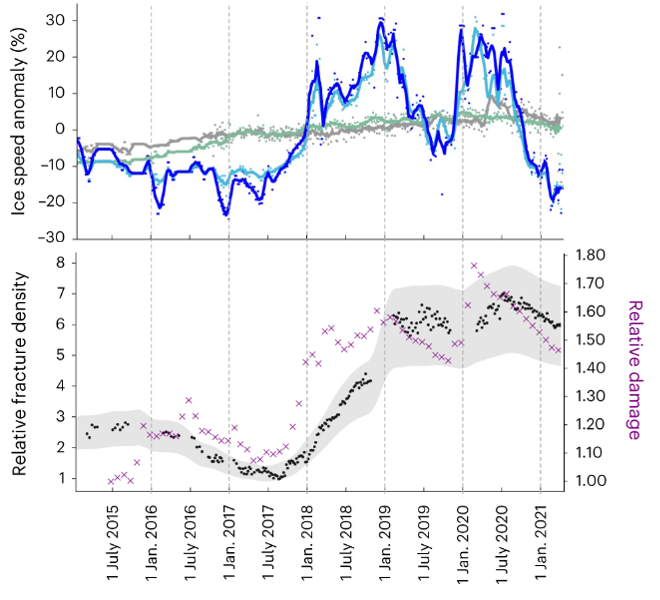
A key alliance result is illustrated by the paper Episodic dynamic change linked to damage on the Thwaites Glacier Ice Tongue, which analysed six years of Sentinel-1 satellite observations of ice speed, fracture patterns and ice-tongue geometry. The study found two major episodes of speed variation across the Thwaites Glacier Ice Tongue between 2015 and 2021, with changes of approximately 30 to 45% over monthly to annual timescales. Using a deep-learning method to map fractures from satellite imagery, the research showed that periods of increased crevassing and subsequent reconsolidation coincided with these speed changes.
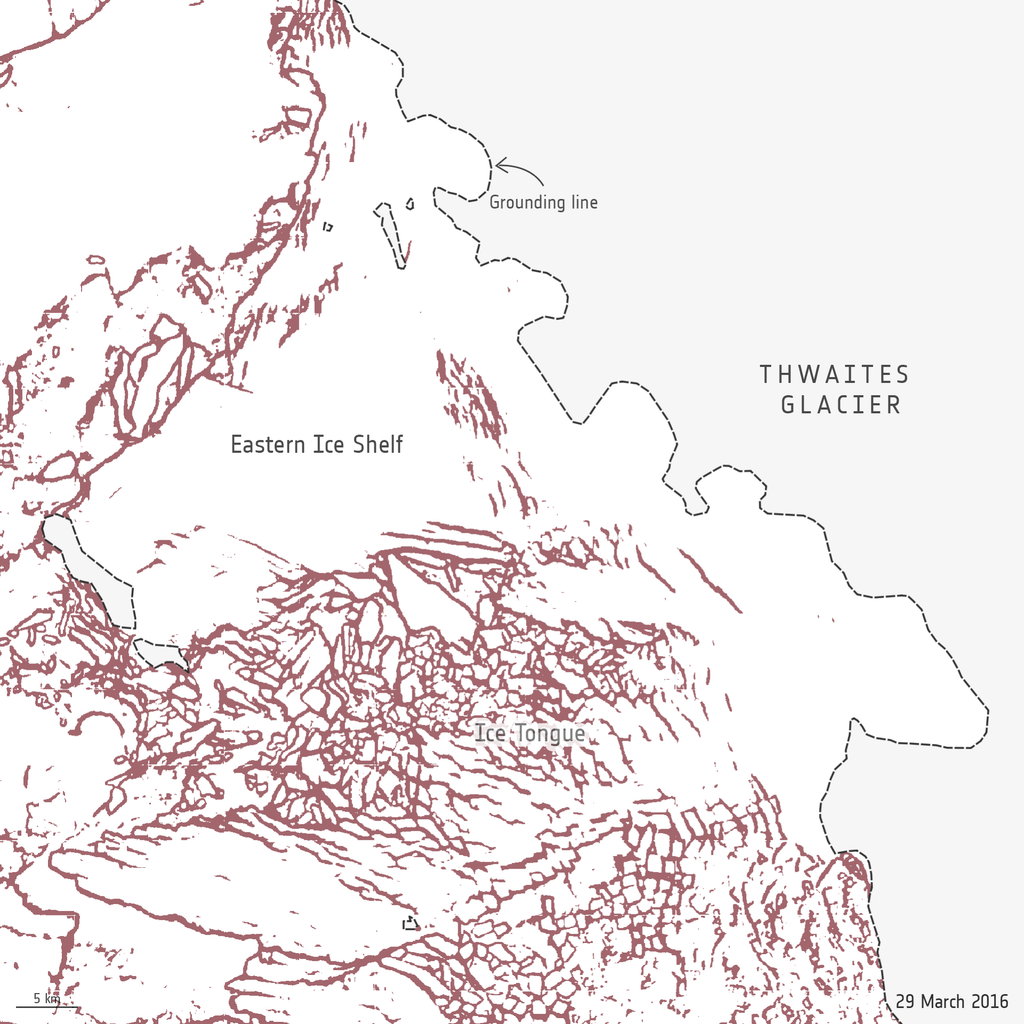
Importantly, inverse modelling with the BISICLES ice-sheet model showed that the observed speed variations could be largely accounted for by changes in the spatial pattern of fracturing. This provides strong evidence that structural damage and dynamic variability are directly coupled in West Antarctica. At the same time, the results show that increased fracturing and associated acceleration are not necessarily irreversible on one- to two-year timescales, as the ice tongue also experienced periods of deceleration and partial reconsolidation.
By linking dense satellite time series, automated fracture mapping and process-based modelling, the alliance strengthens Europe’s ability to monitor and interpret rapid changes in vulnerable Antarctic ice shelves. It also highlights the need for future ice-sheet models to represent damage processes more realistically, so that projections of Antarctic ice loss and future sea-level rise can better capture short-term variability as well as long-term trends.