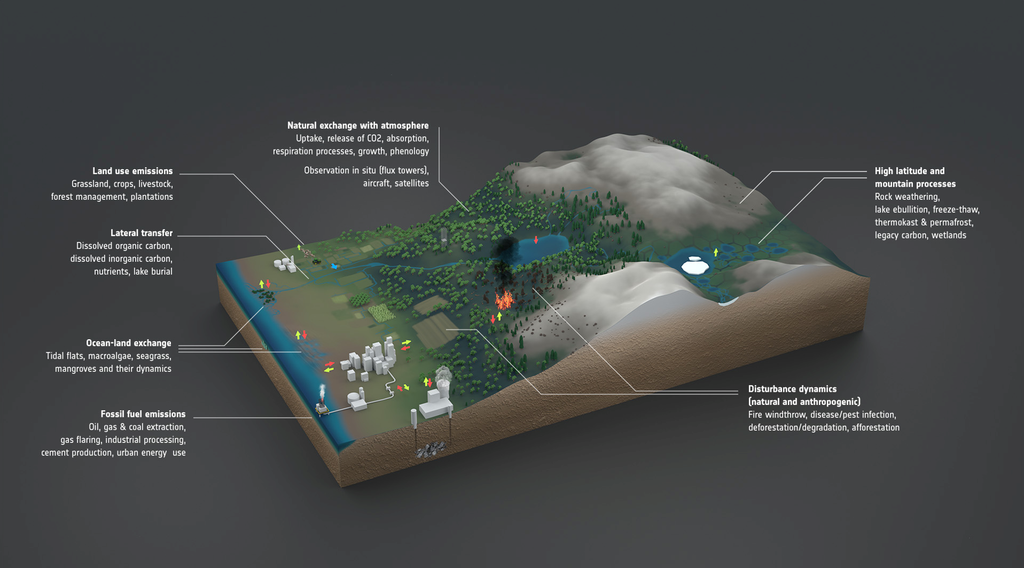
Understanding and monitoring the terrestrial carbon cycle requires observations that span ecosystems, spatial scales and timeframes: from field measurements and flux towers to satellite observations covering entire regions and continents. Today, these resources are often accessed and used by separate scientific communities, with inconsistent access, formats, resolution and representativeness. This limits their effective use to parameterize or constrain large-scale land surface models e.g. ORCHIDEE or JULES or for data assimilation, as well as downstream practical application such as assessing forest recovery, interpreting changes in carbon exchange measured at observation sites and attributing changes in terrestrial carbon stocks and fluxes.
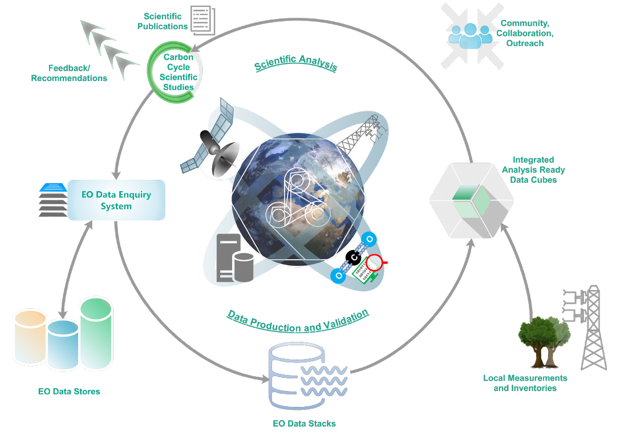
In addition to improving access to data, there is a growing need to ensure that terrestrial carbon datasets are easy to find, interoperable, analysis-ready and usable by a broad range of stakeholders, from domain experts to policy makers, moving towards FAIR principles where possible. This requires harmonised data structures, transparent documentation of uncertainties and assumptions, scalable processing approaches, and mechanisms to ensure long-term stewardship and discoverability of critical datasets beyond the lifetime of individual projects.
This alliance brings together five ESA Carbon Science Cluster projects (THRAC3E, EOLINCS, EO4BK, EOWetMet and SENSE4FIRE) with three complementary Horizon Europe projects (CONCERTO, NextGenCarbon and MISO) to promote a coordinated, user-driven approach to developing and applying Earth Observation data and tools for terrestrial carbon science. The projects bring together complementary expertise in data infrastructure, software engineering, in-situ observation, satellite-based Earth Observation, carbon-cycle modelling and carbon accounting. The alliance aims to align methodologies and promote common standards for data management, validation and interoperability.
More than the sum of individual projects
Together under this ESSI alliance, these eight projects have one shared goal: to make their outputs in terms of terrestrial carbon observations and models easily discoverable, harmonised and scientifically usable across all scales, from single wetlands, national assessments, and regional and global carbon budgets.
The alliance develops a joint framework to:
- Define priority datasets and scientific use cases, connecting the requirements of carbon-cycle researchers with available and emerging EO and in-situ observations.
- Ensure long-term, harmonised datasets for local, regional, and global applications, including historical reconstructions to improve carbon budget calculations and ultimately for reporting change in carbon stocks and fluxes.
- Improve access, interoperability and analysis-readiness of carbon-related datasets, building on tools and complementary data infrastructures developed through projects e.g. EO-LINCS.
- Connect observations with modelling and data assimilation, using requirements and applications from THRAC3E, NextGenCarbon, CONCERTO and other carbon-cycle research activities to evaluate the scientific value of available datasets.
- Integrate specialised observations into this framework, including MISO’s in-situ greenhouse-gas measurements and observations relevant to wetlands, methane emissions and other carbon-cycle processes.
- Create a carbon-cycle knowledge inventory that maps policy needs and scientific gaps covering both the entire cycle and its specific components.
- Share knowledge, methods, best practices and emerging results, using both the carbon-cycle knowledge inventory above and the community forum developed through THRAC3E, CONCERTO and NextGenCarbon to connect researchers and facilitate collaboration between EO, Earth system modelling and other related communities.
The alliance is open to other projects and initiatives interested in contributing to this community, sharing their requirements and use cases, or making their datasets and tools available for wider carbon-cycle applications.
From individual capabilities to joint outcomes
Individual projects contribute complementary building blocks to the jointly developed vision of the alliance:
- The ESA EO-LINCS project produced open-source software to access main data sources used by carbon science community in a seamless manner. Four science case pipelines are publicly available including also access to the core framework – xcube-multistore from where data can be extracted and exploited.
- The EC project CONCERTO focuses on data standardization, supported by a task force developing shared ontology and consistent definitions for all datasets used across the projects.
- The EC project NextGenCarbon brings the modelling and data-assimilation expertise needed to translate raw observations into carbon-cycle science
- The ESA THRAC3E project directly builds on the NRT-Carbon Extremes and Sense4Fire projects extending the datasets into a more regionally relevant system. THRAC3E’s core deliverable will be a benchmarking dataset that integrates EO and in-situ observations within a cloud-native data cube, built explicitly around FAIR principles and open access. This underpins and contributes to the alliance’s proposed centralised catalogue that spans multiple regions, biomes, and data types (fire emissions, canopy structure, vegetation dynamics) rather than a single narrow product line. THRAC3E’s carbon-cycle knowledge inventory and community forum, meanwhile, are designed precisely to map available datasets and models against scientific gaps and policy needs but tested first within THRAC3E’s own regional context.
Why is the alliance important to the carbon community?
The alliance aims to strengthen the scientific evidence base feeding into IPCC and other scientific assessments underpinning climate strategies e.g. monitoring and reporting under the EU LULUCF Regulation. This and other policy instruments require more accurate and timely information on land, soil and biomass carbon stocks and the alliance contributes by improving the availability, interoperability and scientific usability of terrestrial carbon observations, with a particular focus on the role of advanced monitoring technologies such as satellite observations in combination with in situ measurements and modelling to convert the observations into the products that are needed to address policy requirements.
Additionally, for the third Regional Carbon Cycle Assessment and Processes (RECCAP3) Initiative of the Global Carbon Project, which focuses on regional and national carbon budgets, a stronger effort is needed to ensure data are accessible and usable for national experts. This includes:
- definition of minimum dataset requirements for cross-initiative analyses (validation, pixel-level uncertainty, metadata);
- use of platforms like the ESA-NASA Multi-Mission Algorithm and Analysis Platform (MAAP) for intercomparison exercises (e.g., Biomass Harmonisation) and align with RECCAP benchmarks;
- explore mechanisms for provision of a standard data repository accessible to all participants of RECCAP-3.