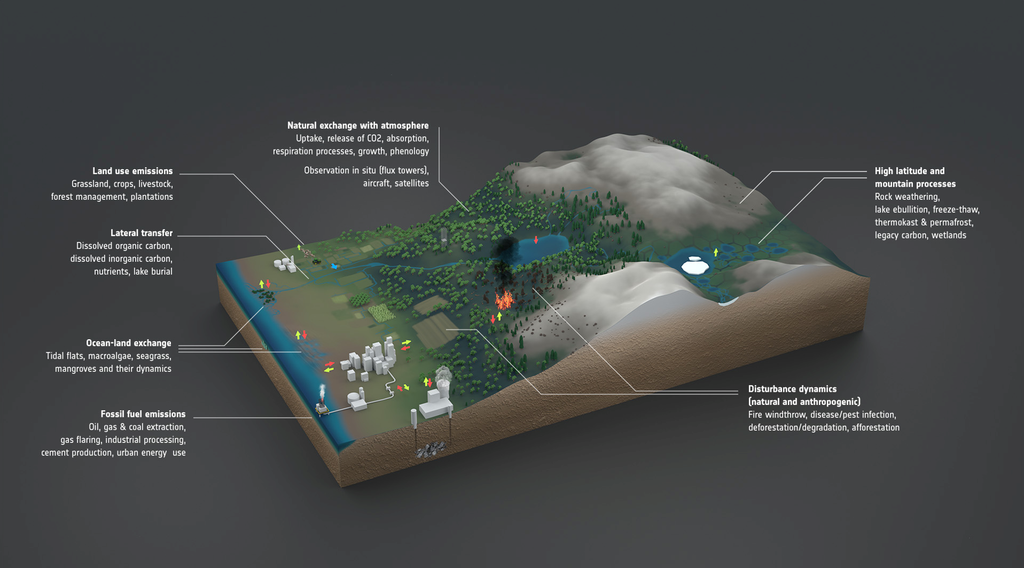
National inventories and global carbon budgets can produce different estimates of land-based carbon fluxes because they use different system boundaries, spatial and temporal resolutions, attribution methods and data sources. Reconciling these estimates requires connecting bottom-up inventories and ecosystem observations with process-based models and top-down Earth Observation constraints, while consistently representing the processes driving carbon uptake and release.
The RECCAP assessment provides an international framework for developing comprehensive greenhouse-gas budgets that are consistent across national, regional and global scales. By integrating national inventories with Earth Observation, ground-based measurements, process models and advanced analytical methods, it aims to independently assess natural and anthropogenic sources and sinks of CO₂, CH₄ and N₂O. Its results provide context for national reporting under the Paris Agreement’s Enhanced Transparency Framework, tracking Nationally Determined Contributions and future Global Stocktakes.
Within this broader context, European Commission NextGenCarbon and CONCERTO projects, and ESA’s THRAC3E activity bring complementary capabilities together. NextGenCarbon integrates Earth Observation and in-situ observations into next-generation carbon models; CONCERTO improves the representation of terrestrial ecosystem processes across scales, and provides assessments using EO, process-based and data-driven modelling and THRAC3E develops high-resolution, regionally disaggregated carbon benchmarking.
Their collaboration can address a key limitation that individual projects cannot resolve alone: the lack of a consistent link between observations, models and carbon assessments across scales. By sharing EO datasets (including novel European satellites such as BIOMASS and upcoming FLEX), measurements from the Integrated Carbon Observation System (ICOS), model experiments and evaluation protocols, the projects can jointly benchmark independent estimates, identify the sources of discrepancies between inventories and models, and improve the scaling of ecosystem-level observations to regional, national and global carbon budgets. This creates an iterative connection between observations, model development, regional assessments and global synthesis, strengthening the consistency, transparency and policy relevance of terrestrial carbon information.
Main area of collaboration is the development of improved flux estimates through the FLUXCOM-X framework. THRAC3E directly builds on methodologies developed within NextGenCarbon to better integrate high-resolution satellite observations with flux tower measurements. New approaches using Sentinel-2, VIIRS and flux tower footprint modelling improve the representation of spatial heterogeneity and strengthen the reliability of carbon, water and energy flux estimates across continents. These developments extend pioneering work initially tested at European ICOS sites towards the global FLUXNET2025 network.
The alliance between the projects also promotes the comparison of EO-derived products, dynamic vegetation model simulations, atmospheric inversions and National Greenhouse Gas Inventories (NGHGIs), creating a more complete picture of terrestrial carbon dynamics and strengthening the scientific basis for future policy-relevant assessments.
The three projects are closely aligned with RECCAP-3 and the wider Global Carbon Project, and maintain strong links with the ESA Carbon Science Cluster, ESA CCI and NASA Carbon Monitoring System. This will be supported through training schools, joint conference sessions, and a shared Global Carbon Cycle Forum. Results will also be shared through a dedicated data portal and engagement at major scientific and policy forums, including the Global Stocktake.
Beyond scientific development, the alliance supports a strong programme of coordination, knowledge exchange, and capacity building. Main joint activities include:
- The development of a Carbon Cycle Community Forum, providing an interactive platform for collaboration, sharing insights and advance understanding among researchers and stakeholders from carbon cycle communities.
- Creation of a Carbon Cycle Knowledge Inventory to facilitate sharing of datasets on the carbon cycle from EO, in situ observations, models and scientific results across projects.