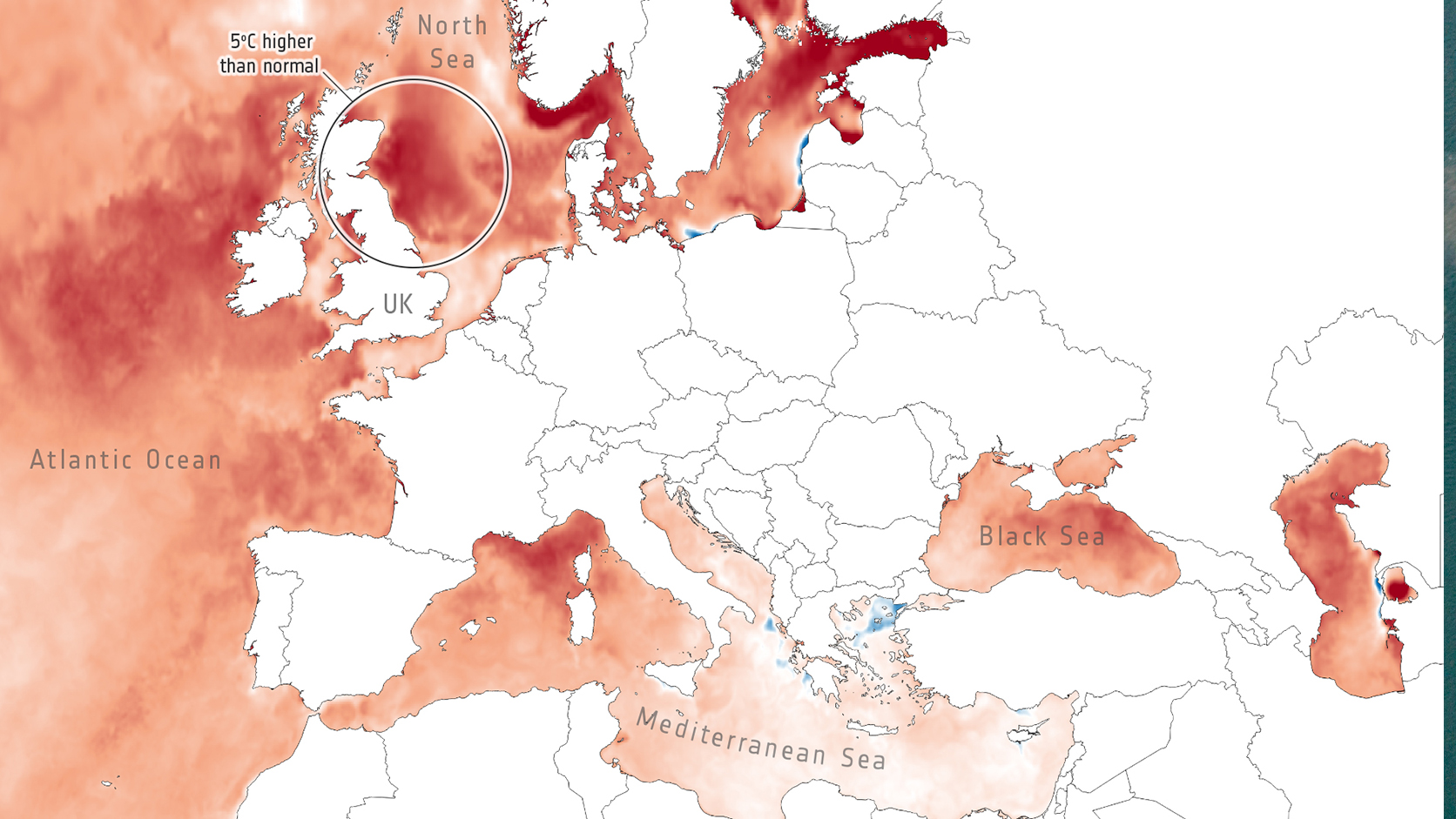
Marine heatwaves (MHWs) are prolonged periods of unusually high seawater temperature that are becoming more frequent and intense under climate change. They can disrupt marine ecosystems, alter species distributions and food-web dynamics, affect biogeochemical cycles and ecosystem services, and interact with other stressors to amplify ecological impacts. Yet, important challenges remain in consistently detecting and characterising marine heatwaves, observing their evolution below the surface, understanding their drivers and predicting their ecological consequences.
This alliance brings together the European Commission projects LandSeaLot and GES4SEAS and ESA’s CAREHeat project to connect observation, process understanding and ecosystem assessment. CAREHeat develops improved MHW detection methods and global and regional surface and subsurface datasets by combining satellite observations, in-situ measurements and modelling. LandSeaLot works to integrate satellite, in-situ, modelling and other observations at the land–sea interface, addressing gaps between observing communities and data sources. GES4SEAS provides an ecosystem-based framework for assessing cumulative pressures, environmental status, ecosystem responses and ecosystem services.

The collaboration creates a pathway from observing marine heatwaves to assess their consequences for marine ecosystems. CAREHeat’s Global MHW Atlas covers 1980–2024 and provides daily information on the location, intensity, duration and frequency of events, while its 4D reconstruction extends MHW analysis from the surface to 300 m depth (for a shorter period). These datasets can be combined with the broader observations and integration approaches developed by LandSeaLot and with GES4SEAS tools for analysing ecosystem responses, cumulative pressures and environmental status.
Building on the project outcome, the CAREHeat consortium has organized from 13th to 16th October 2025 the workshop “Marine Heat Waves From Space: from detection to prediction”.
The event gathers 25 experts from 11 countries, including partners from the LandSeaLot and GES4SEAS projects, to exchange insights and shape future research around four core objectives: improving MHW detection, enhancing observability, advancing predictability, and assessing impacts. As major outcome, a White Paper entitled “Marine heatwaves from space: the role of Earth Observation in detection, prediction, and impact studies” summarizing key challenges and opportunities and outlining a roadmap for future MHW-related activities, has been submitted for review to Progress in Oceanography.
