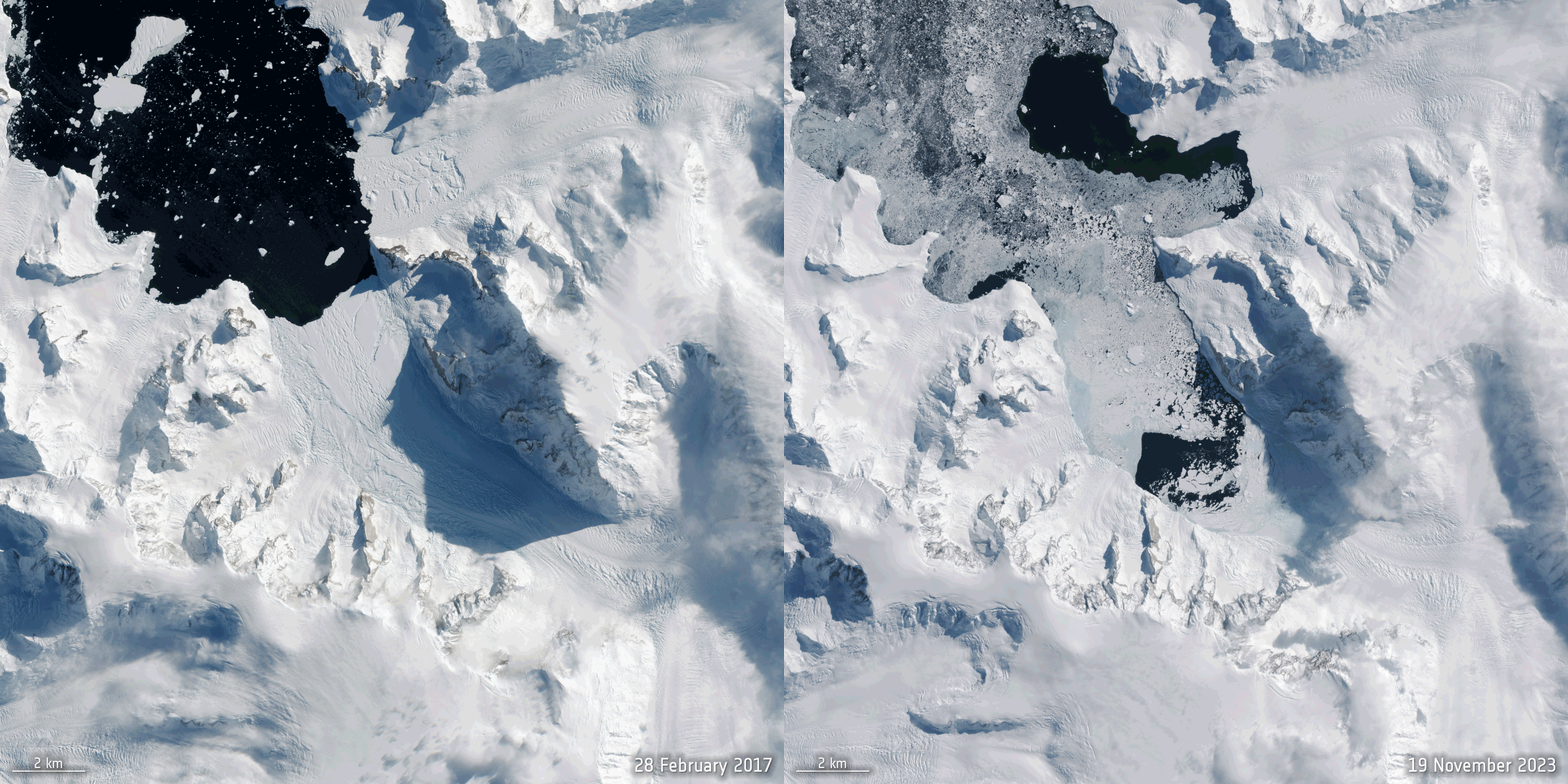
New research has revealed how rising ocean temperatures are driving rapid changes in Antarctica, highlighting the growing vulnerability of a continent once thought to be relatively resilient to the immediate impacts of climate change.
Using observations from nine satellite missions, including ESA’s CryoSat and Europe’s Copernicus Sentinel-1, scientists found that the ice shelf supporting Cadman Glacier on the west Antarctic Peninsula collapsed after years of weakening from below. Exposed to unusually warm ocean waters, the glacier subsequently accelerated and retreated at an unprecedented rate.
Published in Nature Communications, the study was carried out by researchers from the University of Leeds, Lancaster University, ENVEO, the University of Delaware and the British Antarctic Survey, combining satellite observations with in-situ measurements to track changes in the glacier system over time.
The collapse of a natural barrier
Ice shelves play a critical role in Antarctica’s ice system. Floating on the ocean but often anchored to the seabed, they act as natural barriers that slow the flow of glaciers into the sea.
Researchers found that unusually warm ocean waters around the west Antarctic Peninsula in 2018–2019 weakened the Cadman Ice Shelf to the point that it detached from its grounding zone. Once this natural anchor was lost, the glacier was no longer restrained and began flowing more rapidly towards the ocean.
Satellite measurements show that between November 2018 and May 2021, Cadman Glacier retreated by approximately eight kilometres after having remained relatively stable for around 50 years. The glacier also experienced a dramatic increase in ice discharge, while its surface continued to thin by around 20 metres each year.
Lead author Benjamin Wallis from the University of Leeds explained that warmer-than-average ocean waters, up to 2°C above normal, were observed near the glacier in 2018. The warm water extended deep into the water column and likely reached the base of the ice shelf, causing it to melt from below over many years before ultimately destabilising the system.
A potential glaciological tipping point
The researchers describe Cadman Glacier as an example of a “glaciological tipping point”, a threshold beyond which a seemingly stable glacier can undergo rapid and potentially irreversible change.
Following the loss of the ice shelf’s support, Cadman Glacier increased its ice discharge by around 28% within just 13 months and is now considered to be in a state of substantial dynamic imbalance. Today, an estimated 2.16 billion tonnes of ice are draining from the glacier into the ocean each year.
Interestingly, neighbouring glaciers in the same region have not shown the same response, suggesting that local conditions can strongly influence how Antarctic glaciers react to climate-driven changes. Understanding these differences is essential for improving future projections of ice-sheet loss and sea-level rise.
Satellites essential for monitoring Antarctica’s future
The study provides further evidence that warming oceans represent a major threat to the Antarctic ice sheet and can trigger rapid glacier retreat with little warning. As Antarctic ice loss contributes to global sea-level rise, monitoring these changes is becoming increasingly important.
Researchers stress that continued observations are needed to better understand the complex interactions between the ocean, glaciers and ice shelves. Satellite missions provide a unique capability to monitor the continent consistently over long periods and across vast, inaccessible regions.
ESA’s Mark Drinkwater noted that Antarctica is proving to be more sensitive to environmental change than previously expected. While missions such as CryoSat and Copernicus Sentinel-1 continue to deliver critical observations, future missions – including the Copernicus Sentinel Expansion Mission CRISTAL and Sentinel‑1 Next Generation – will play a vital role in sustaining and enhancing measurements of the polar regions for decades to come.

This results build on knowledge and expertise developed through the SO-ICE, POLAR+ Ice Shelves, SO-CHIC, and OCEAN:ICE projects, whose combined research efforts are improving our understanding of the interactions between the Southern Ocean, Antarctic ice shelves and glaciers, and their influence on global climate and sea-level rise.